Start with height, then check capacity. A 350ml glass can be taller than a 450ml mug. Measure from the surface your glass will actually sit on to the lowest fitted coffee outlet, then leave your own allowance for moving it in and out.
Measure the setup you actually use
- Set up the machine as normal. Fit the drip tray, cup platform and portafilter you normally use. Make the measurement with the machine idle and cool.
- Put your scales in place, if you use them. Measure upward from the top of the scales, not from the tray beneath them. If you measure from the tray instead, subtract the scales’ height once.
- Find the lowest obstruction. The fitted portafilter spouts may hang lower than the machine body. Measure the space where the glass needs to enter as well as where it will stand.
- Choose a handling gap. An exact-height match leaves no room to lift the glass over a tray lip. There is no universal allowance: check the movement your machine requires.
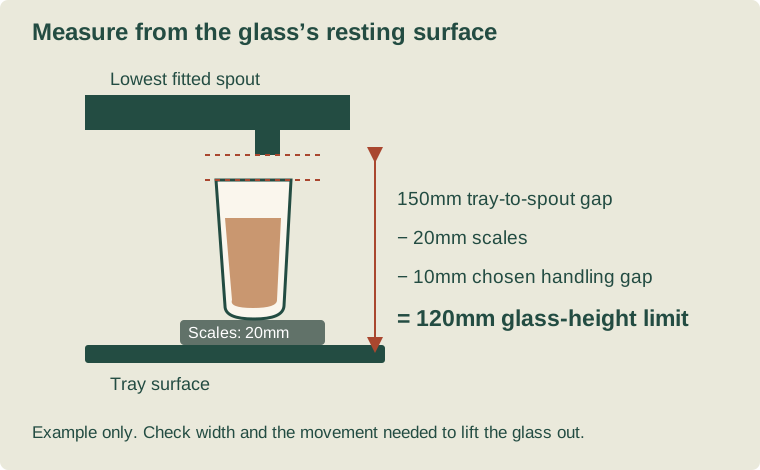
The simple height calculation
Maximum glass height = measured usable gap − your chosen handling gap. The usable gap starts at the surface supporting the glass, including any scales. Do not subtract their height again if you already measured from their top.
| Setup | Usable gap | Chosen allowance | Glass-height limit |
|---|---|---|---|
| 150mm gap, no scales | 150mm | 10mm | 140mm |
| 150mm gap, 20mm scales | 130mm | 10mm | 120mm |
| 120mm measured above scales | 120mm | 10mm | 110mm |
For the middle example, a 125mm glass exceeds the 120mm planning limit. A 120mm glass meets that calculation, but its width, base and removal path still need checking. The 10mm allowance here is an example you choose, not a safety standard.
Use the glass finder with your own measurements → Enter the usable gap under “Space below spout” and put your chosen allowance under “Handling gap”. The finder also checks the capacity you need.
What fits a De’Longhi Dedica Style EC685?
De’Longhi’s UK page for the EC685.BL EX:4 describes a two-tier cup holder accommodating glasses up to 12cm tall. That is 120mm, for the stated model and tray arrangement; it is not a measurement for every Dedica model or for a setup with extra scales.
As a useful counterexample, ZWILLING lists its Sorrento 350ml glass, item 39500-078-0, at 13.9cm high. That is 139mm: 19mm taller than the EC685 figure. It should therefore not be selected for direct brewing on the basis of those published dimensions. This is a specification comparison, not a hands-on fit test.
Check your exact model and fitted accessories before buying. The manufacturer sources below support these two measurements; they are reference links, not product recommendations.
Three checks a height figure cannot answer
- Base support: compare the glass’s base diameter with the flat, supported area of the tray or scales. Do not assume a wide rim means a wide base.
- Handle and rim clearance: check space beside the machine and beneath both spouts. A handle can make a mug wider than the quoted body diameter.
- Room to remove it: consider tray lips, raised scales and the path out. A glass that fits while empty must still be manageable when full.
Capacity and height are separate decisions
Use the finished drink volume, including foam or ice, when choosing capacity. Add your preferred headroom rather than filling to the rim. Then check the glass’s actual external height; the capacity in millilitres does not tell you its shape.
Compare latte glass capacities or read the iced latte sizing guide. Once you know both numbers, filter the current glass shortlist by capacity and maximum height. An empty result means that shortlist has no match; it is not a reason to ignore your measurements.
If your favourite glass is too tall
Use only tray arrangements described in the instructions for your particular machine. Do not prop the machine up, balance the glass over an edge or force it beneath the outlet. A shorter suitable vessel for brewing, followed by a careful transfer to the serving glass, may be more practical.
Before ordering, save a note with your machine model, usable gap, chosen handling allowance, tray width and finished drink volume. Check product dimensions rather than parcel dimensions. If height or base width is missing, ask the seller instead of estimating from a photograph.